 Spanish
  Italian
  Polish
  English
  Arabic
  Turkish
  Russian
  French
  Chinese
  Deutsch
  GBP
GBP  EUR
EUR 

 Destination Guides

Prague Travel Guide: Castles, Charles Bridge and Bohemian Charm
Prague survived the twentieth century almost untouched, and walking its streets feels like stepping into a storybook that never closed. Gothic spires, Baroque palaces, an astronomical clock older than Columbus's voyages — and beneath it all, a beer culture so good it's practically a religion. Few European capitals deliver so much beauty for so little money.
Why Visit Prague?
Prague is Europe's best-preserved great city: the largest ancient castle complex in the world, a medieval old town of cobbles and towers, and the Charles Bridge's statue-lined crossing — all compressed into a centre you can cross on foot. Add world-class beer at two euros a pint and a serious classical music scene, and Prague punches far above its size.
Best Time to Visit Prague
May, June and September bring warm days, beer-garden weather and manageable crowds. July and August are peak season — book ahead. December trades crowds for Christmas markets and mulled wine in the Old Town Square; January and February are cold, atmospheric and cheap, with the castle views to yourself.
Top Things to Do in Prague
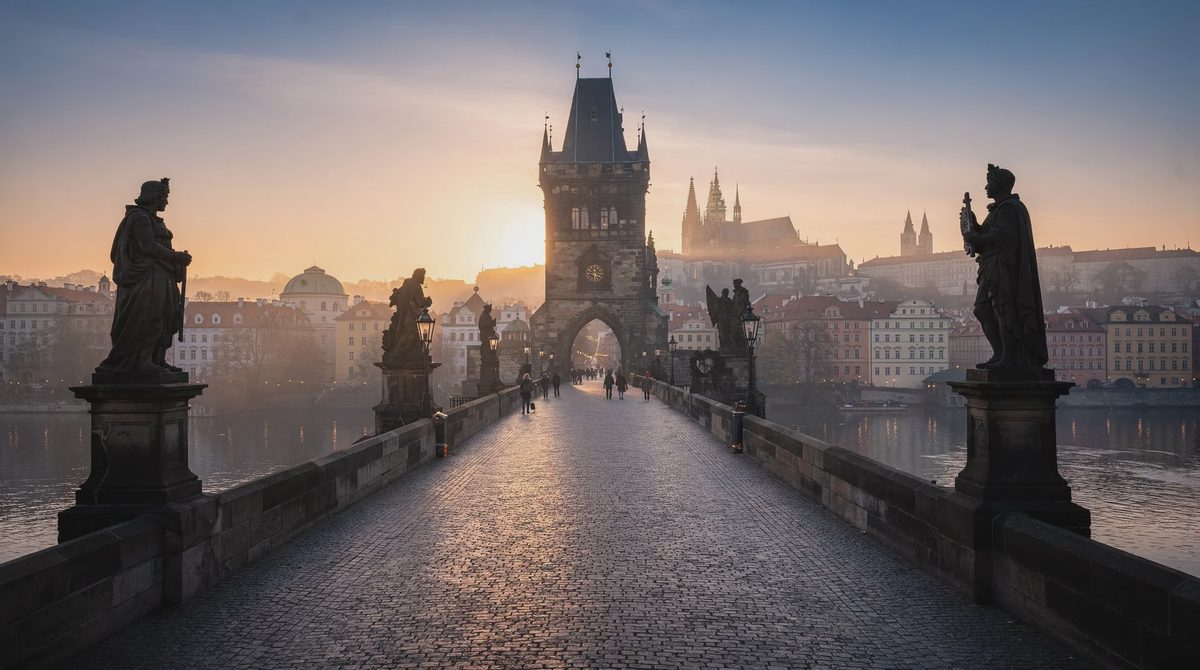
Charles Bridge at dawn: The 14th-century bridge is Prague's soul — thirty Baroque statues, castle views, and at sunrise, almost nobody. Return at night when it's lit and lively with musicians.
Prague Castle: A hilltop city within a city: St Vitus Cathedral's soaring nave, Golden Lane's tiny coloured houses, and the changing of the guard. Buy the circuit ticket, allow half a day, and walk down through the castle gardens.
Old Town Square: Watch the Astronomical Clock strike the hour (arrive five minutes early), admire the Týn Church's twin spires, and duck into the Municipal House for Art Nouveau splendour.
Jewish Quarter (Josefov): Europe's best-preserved Jewish ghetto — the Old Jewish Cemetery's layered gravestones and the synagogues of the Jewish Museum are deeply moving. Book tickets ahead.
Beer and food halls: Drink unfiltered Pilsner at a tank pub (Lokál is the classic), try svíčková and dumplings in a vaulted cellar, and don't skip the trdelník debates — locals will tell you it's for tourists, and they're right; eat lángos or a proper koleno (pork knuckle) instead.
Day trips: Kutná Hora's bone church, Český Krumlov's fairytale lanes, or the Bohemian Switzerland national park's sandstone arches.
Where to Stay in Prague
Old Town (Staré Město) puts everything at your feet. Malá Strana beneath the castle is the romantic choice — Baroque palaces and quiet lanes. Vinohrady and Žižkov offer local neighbourhood life and better-value hotels, twenty minutes by tram from the centre.
Getting Around
Prague's trams and metro are excellent and cheap — a 24-hour pass covers everything including the funicular to Petřín Hill's mini Eiffel Tower. The centre is best walked; cobblestones demand proper shoes. From the airport, bus plus metro or a fixed-price transfer reaches the centre in 40 minutes.
Practical Tips for 2026
Czechia is Schengen; the currency is the koruna (CZK) — pay by card or withdraw from bank ATMs, never exchange offices on the square. In restaurants, check your bill — service is sometimes included. Tap water is safe. Book castle, Jewish Museum and popular concerts in advance. Taxis: use apps (Bolt, Uber) or AAA — street hails overcharge tourists.
The Bottom Line
Prague rewards the early riser and the aimless wanderer: bridge at dawn, castle by noon, beer hall by night. Find flights to Prague on Skyvela and write your own chapter.